8 min read
Evacuation, Invacuation or Lockdown: A Practical Guide for Public Buildings
Circle Editor
:
October 6, 2026
Evacuation, invacuation and lockdown are different ways to move people away from danger. Evacuation takes people out of a building or affected area. Invacuation moves them to a safer place inside. Lockdown secures all or part of the premises to prevent people entering or leaving.
For a public building, choosing the wrong response can move occupants towards a threat, create congestion or expose people at an unsafe assembly point. The answer is not to select one universal procedure. It is to prepare flexible, site-specific arrangements that help trained people make sound decisions with the information available.
This practical guide is for local authorities, NHS organisations, education providers, cultural venues and other operators of publicly accessible buildings in the UK. It explains how to plan, communicate, test and improve evacuation, invacuation and lockdown procedures.
What is the difference between evacuation, invacuation and lockdown?
The National Protective Security Authority guidance on evacuation, invacuation and lockdown identifies three primary ways to get people away from danger. It also makes clear that an incident may require a combination of procedures and that plans must be adaptable.
Evacuation
Evacuation means moving people out of the premises, or out of the affected part of it, and away from danger. It may be appropriate when the threat is inside the building and safe routes lead occupants away from it.
A security evacuation should not simply copy the fire procedure. A suspicious item near the normal exit, an attack outside or uncertainty about the location of a threat may make familiar routes and assembly points unsafe. Plans should therefore identify alternatives, including directional and phased evacuation.
Invacuation
Invacuation means moving people to a safer place within the premises. It can also involve bringing people inside from an exposed external area. It may be the safer response when danger is outside, when the threat location is uncertain or when evacuation would move people towards harm.
Suitable internal areas depend on the hazard and the building. They need adequate capacity, accessible routes and a way to communicate with the people sheltering there. A location that is suitable for one scenario may be unsuitable for another.
Lockdown
Lockdown means securing the whole premises or selected zones to control entry and exit. It can deter or delay an attacker, restrict movement and prevent occupants from entering a dangerous area.
Lockdown does not always mean sealing every door. Depending on the building and incident, the response could be full, partial, one-way or zonal. It may follow an invacuation, or be combined with a directional evacuation from a different part of the site.
| Response | Primary purpose | Typical consideration |
|---|---|---|
| Evacuation | Move people out and away from danger | Are the exits, routes and destination safe? |
| Invacuation | Move people to a safer internal area | Which internal areas offer the lowest exposure? |
| Lockdown | Control access and movement | Which doors or zones can be secured without creating another hazard? |
Why a fire evacuation plan is not enough
Fire procedures usually assume that people should leave by a safe exit and gather outside. During a hostile incident, the threat may be near an entrance, on an evacuation route or at the assembly point. A spontaneous mass evacuation can also overload corridors and stairwells.
Public buildings need emergency arrangements that distinguish between fire and security incidents. The alert, decision authority, route, destination and instructions may all be different. Staff must recognise those differences, particularly at reception points, public counters, security desks and control rooms.
The procedures must still work together. Security actions cannot compromise fire safety, health and safety duties or accessible escape arrangements. The goal is a coherent emergency framework, not a collection of conflicting plans.
How Martyn’s Law affects public building preparedness
The Terrorism (Protection of Premises) Act 2025, commonly known as Martyn’s Law, identifies evacuation, invacuation, lockdown and communication as public protection procedures. As at October 2026, the substantive compliance requirements are not yet in force and are expected in spring 2027. Organisations can use the implementation period to review their premises and prepare.
ProtectUK’s Martyn’s Law frequently asked questions explains that premises expecting 200 to 799 people at the busiest times are likely to fall within the standard tier when the other scope tests are met. Premises expecting 800 or more are likely to fall within the enhanced tier. The assessment includes staff and must be specific to the premises.
Legal scope matters, but sensible preparedness should not begin and end with a threshold. A smaller public building can still face a serious incident. Clear roles, workable procedures and proportionate training protect people even where a site falls outside the Act.
For a wider overview of responsibility, tiers and preparation, read Understanding Martyn’s Law: Ensuring Preparedness at Your Premises.
How to decide which response to use
No static flowchart can replace judgement during a fast-moving incident. A useful decision framework helps the authorised person assess the situation quickly and communicate a clear instruction.
1. Establish where the danger is
Is the threat inside, outside, at an entrance or in the immediate vicinity? Is its location confirmed or uncertain? The answer affects whether people should move out, move in, remain where they are or use a different zone.
2. Check the safety of routes and destinations
Consider exits, internal corridors, stairwells, vehicle routes, public spaces and assembly points. A destination is only useful if people can reach it without increasing exposure. Alternative routes and safe areas should be identified before an incident.
3. Consider who is present
Public buildings may contain employees, visitors, contractors, children, patients, volunteers and people unfamiliar with the premises. Plans should account for occupancy at different times, language and communication needs, mobility, sensory or cognitive impairments, and the possibility that usual staff are absent.
4. Assess what can be controlled
Can doors be secured quickly? Can selected zones be isolated? Can access control release safely during a fire alarm? Can CCTV or staff observations provide reliable information? The procedure must match the building’s actual systems, not an idealised design.
5. Keep options open
The safest response may change as information develops. An initial lockdown may be followed by invacuation or evacuation. A large site may use different actions in separate zones. Plans should define who can alter the response and how the change will be communicated.
How to create site-specific procedures
Define ownership and decision authority
Name the person or role responsible for initiating each procedure and identify deputies for all operating periods. Set out how information is escalated, who contacts the emergency services and when operational control transfers to them.
Map the premises
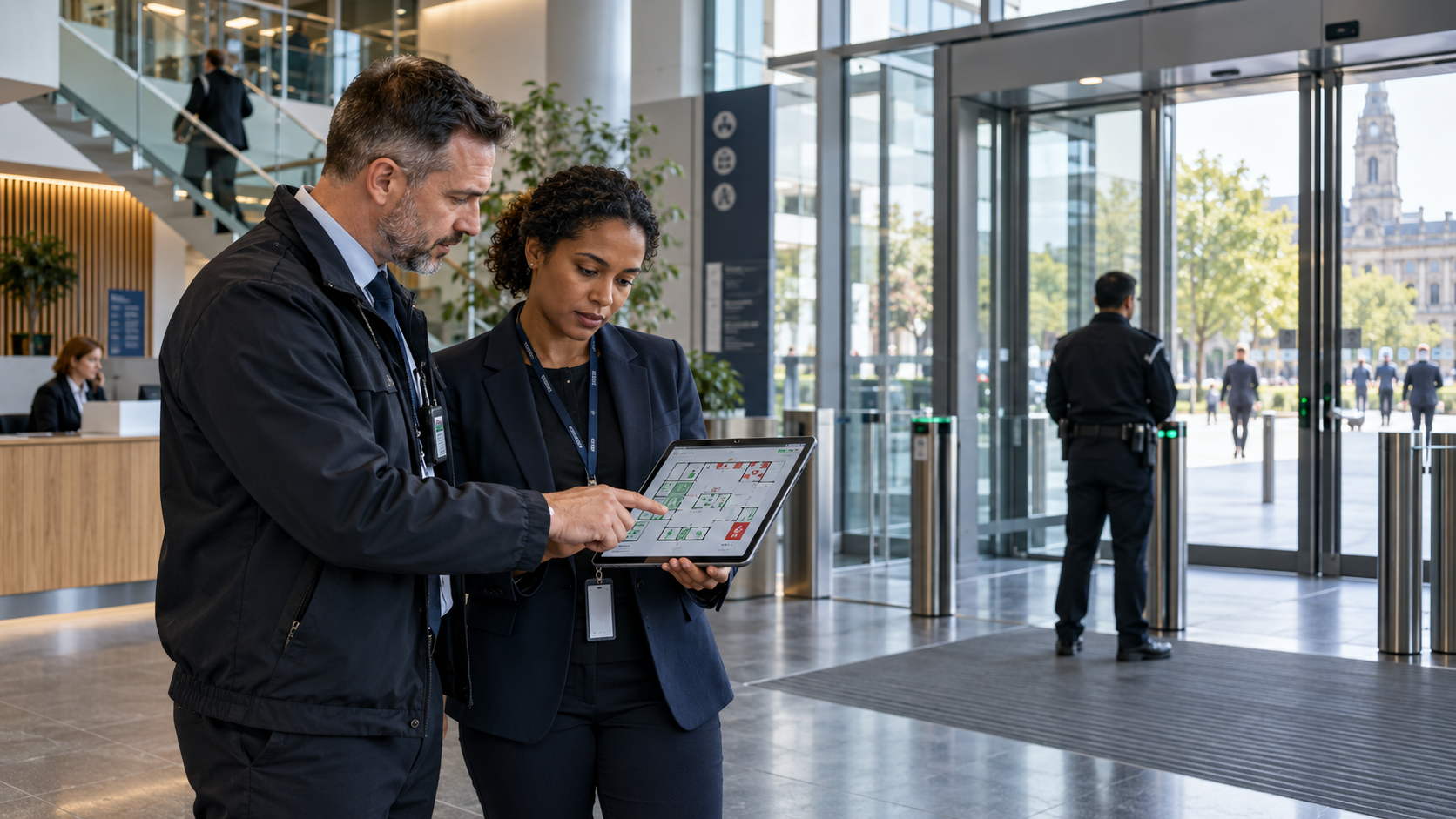
Record entrances, exits, internal zones, secure doors, refuge points, safe areas, assembly points, control rooms and emergency-service access. Check how those features work during normal hours, reduced staffing, events and maintenance.
Write short, role-specific instructions
A lengthy policy is difficult to use under pressure. Give reception staff, facilities teams, security personnel, managers and frontline employees concise instructions for their responsibilities. Include actions to avoid, as well as actions to take.
Plan communications before movement
People cannot follow a procedure they do not understand. Decide how alerts will reach employees, visitors and contractors using available public-address systems, radios, alarms, screens, messaging tools and direct instructions. Use distinct, plain language and provide accessible alternatives where needed.
Include visitors and vulnerable occupants
Do not assume that everyone can hear an alarm, use stairs, read a screen or understand the building. Reception and event teams need a way to brief visitors without causing confusion. Personal emergency evacuation arrangements should connect with wider security procedures, while avoiding dependence on one named colleague.
Co-ordinate with neighbours and partners
Many public buildings share entrances, concourses, car parks, service yards or security systems. Clarify responsibilities with landlords, tenants, contractors, event organisers and neighbouring premises. Conflicting instructions from different organisations can increase risk.
Prepare for emergency-service access
Lockdown can make entry difficult for responders. Plans should explain how police, fire and ambulance services can access the premises, how keys or override controls are managed, and who can provide current information about occupants, hazards and secured zones.
How to train and test the plan
Documents alone do not create preparedness. People with responsibility for implementing procedures need to understand the plan, practise their role and know how to adapt when assumptions change.
-
Briefings: introduce the purpose, terminology, alerts and individual responsibilities.
-
Tabletop exercises: give decision-makers a realistic scenario and test what they would do with incomplete information.
-
Communications tests: confirm that alerts reach different zones, shifts and user groups.
-
Walkthroughs: inspect routes, doors, safe areas and control points with the people who will use them.
-
Proportionate drills: rehearse movement and lockdown actions without creating unnecessary risk or distress.
Exercises should include evenings, weekends or reduced staffing where relevant. Give advance notice and support when a scenario could affect vulnerable people. After every test, record what worked, what failed, who owns each action and when it will be completed.
Common planning mistakes
-
Using fire procedures for every incident: the normal exit or assembly point may be unsafe.
-
Choosing one response for the whole site: a zoned building may need simultaneous but different actions.
-
Writing plans around senior staff: incidents can occur when usual decision-makers are absent.
-
Relying on one alert channel: noise, system failure or accessibility needs can prevent a message being received.
-
Ignoring visitors and contractors: they may not recognise local terminology or know where to go.
-
Assuming doors behave as expected: access control, fire release and manual overrides must be tested together.
-
Publishing sensitive details: share operational information with those who need it and protect details that could expose vulnerabilities.
-
Failing to learn from exercises: testing has limited value unless actions are assigned and completed.
Public building preparedness checklist
-
Have we defined evacuation, invacuation and lockdown for this specific premises?
-
Do we know who can initiate, modify and end each response?
-
Have we identified safe routes, alternatives, internal areas and assembly points?
-
Can we communicate clear instructions across every occupied zone?
-
Do procedures work for disabled people and others who may need assistance?
-
Are visitors, contractors, volunteers and temporary staff included?
-
Can emergency services enter and receive accurate site information?
-
Have shared responsibilities been agreed with landlords, tenants and partners?
-
Have procedures been tested across realistic staffing and occupancy conditions?
-
Is there a schedule for review after exercises, incidents and operational changes?
Build procedures that work under pressure
The difference between evacuation, invacuation and lockdown is straightforward. Applying the right response in a complex public building requires preparation. Start with the site, the people and credible scenarios. Set clear authority, provide accessible instructions, test the plan and improve it as the premises and threat environment change.
Circle UK Group supports public sector organisations with security risk assessments, emergency and lockdown planning, physical security, trained personnel and integrated risk management. To discuss a site-specific review, contact us.
This article provides general information and does not constitute legal, regulatory or specialist security advice. Organisations should assess their own circumstances, refer to current official guidance and seek appropriate professional advice where required.
Frequently Asked Questions
Have Question? We are here to help
What is the difference between evacuation and invacuation?
Evacuation moves people out of a building or affected area and away from danger. Invacuation moves people to a safer place within the premises, or brings people inside from an exposed external area. The safest choice depends on where the threat is and which routes remain safe.
When should a public building go into lockdown?
Lockdown may be appropriate when securing all or part of the premises can prevent people from entering danger, restrict an attacker’s movement or protect occupants from an external threat. The procedure must reflect the building layout and should allow authorised decision-makers to choose a full, partial or zonal response.
Is a fire evacuation plan enough for a security incident?
No. A fire plan is essential, but a security incident may make the normal exit, assembly point or external route unsafe. Public buildings need procedures that explain when evacuation, invacuation, lockdown or a combined response may be required.
Does Martyn’s Law require lockdown procedures?
Martyn’s Law identifies evacuation, invacuation, lockdown and communication as public protection procedures. Organisations in scope will need appropriate and reasonably practicable procedures when the relevant requirements come into force. Each premises must plan for its own circumstances.
Who should decide which emergency response to use?
The plan should name authorised decision-makers and deputies, while recognising that staff may need to take immediate life-safety action if the situation is clear. Roles, escalation routes and the transfer of control to the emergency services should be agreed before an incident.
How often should evacuation, invacuation and lockdown procedures be tested?
There is no single interval suitable for every premises. Test procedures at planned intervals and whenever there is a significant change to the building, occupancy, operating model, threat profile or security systems. Use a mix of tabletop exercises, communications tests and proportionate drills.
How should disabled visitors be included in emergency procedures?
Plans should consider mobility, sensory, cognitive and communication needs from the outset. Identify accessible routes and safe areas, suitable alert methods, assistance roles, evacuation equipment where required and arrangements that preserve dignity without relying on one individual always being present.
What should happen after the immediate incident?
Account for people, support casualties and affected staff, preserve relevant information, co-operate with the emergency services and manage communications. When safe, conduct a structured debrief, record decisions and lessons, assign corrective actions and update the plan.
Posts by Tag
- Security (52)
- News (31)
- Risk Management (20)
- Health & Safety (13)
- Risk Assessment (12)
- Workplace Compliance (12)
- Circle Academy (11)
- HR Compliance (10)
- Warehouse Security (7)
- Security in Construction (6)
- CCTV (5)
- Circle Alarms (5)
- Waking Watch Service (4)
- Manned Guarding (3)
- Circle Overwatch (2)
- Fire Safety (2)
- Demolition Site Security (1)
- Facility Management (1)