How Security Guards Improve Warehouse Safety in 2026
UK warehouses face mounting pressure from theft, unauthorised access, and supply chain disruption. Yet the most effective solution remains...
8 min read
Circle Editor
:
Updated on August 26, 2026
UK warehouses and distribution centres are under increasing pressure to protect stock, people and day-to-day operations.
High-value goods, frequent vehicle movements, contractors, temporary workers, extended operating hours and multiple access points can create security gaps that technology alone may not fully address. These pressures are helping to sustain demand for warehouse security guards who can provide a visible on-site presence, control access, monitor activity and respond when something happens.
For warehouse owners and directors, however, the question should not simply be whether more guards are needed. The more important question is:
Does your security operation have the right combination of people, technology and procedures for the risks your facility actually faces?
For a broader look at these risks, read our Warehouse & Logistics Risk Management Guide for UK Businesses.

The need for warehouse security guards is being shaped by several operational and security pressures:
Theft and unauthorised access
High-value stock concentrated in one location
24/7 warehouse operations
Large numbers of employees, contractors and drivers
Multiple entrances, yards and loading bays
Out-of-hours activity
Complex vehicle movements
Internal security risks
The need for immediate incident response
Greater expectations around operational resilience
CCTV, alarms and access control can identify and record activity, but detection is only one part of effective security.
When an incident occurs, someone still needs to assess what is happening and follow the appropriate response procedure.
This is where trained on-site security personnel continue to play an important role.
A modern distribution centre can hold significant quantities of stock, equipment, vehicles and operational technology. Depending on the facility, this might include electronics, consumer products, machinery, construction materials, food and drink or other high-value goods.
This concentration of assets can create exposure to:
External theft
Opportunistic theft
Internal theft
Unauthorised entry
Vandalism
Vehicle-related incidents
Organised criminal activity
Damage to stock or property
The consequences can also extend well beyond the value of stolen goods.
A security incident may interrupt deliveries, damage critical equipment, prevent access to part of a facility or require significant management time to investigate.
This is why distribution site security should be considered as part of wider operational risk management.
Our guide to Warehouse Security & Risk Management explores how these risks can affect traders, warehouses and distribution networks.
Warehouses are rarely static environments.
Throughout a normal day, a distribution facility might receive employees, agency workers, HGV drivers, couriers, maintenance teams, contractors and visitors. Every movement creates an access-control question:
Who is entering? Why are they there? Where are they authorised to go? How long should they remain on site?
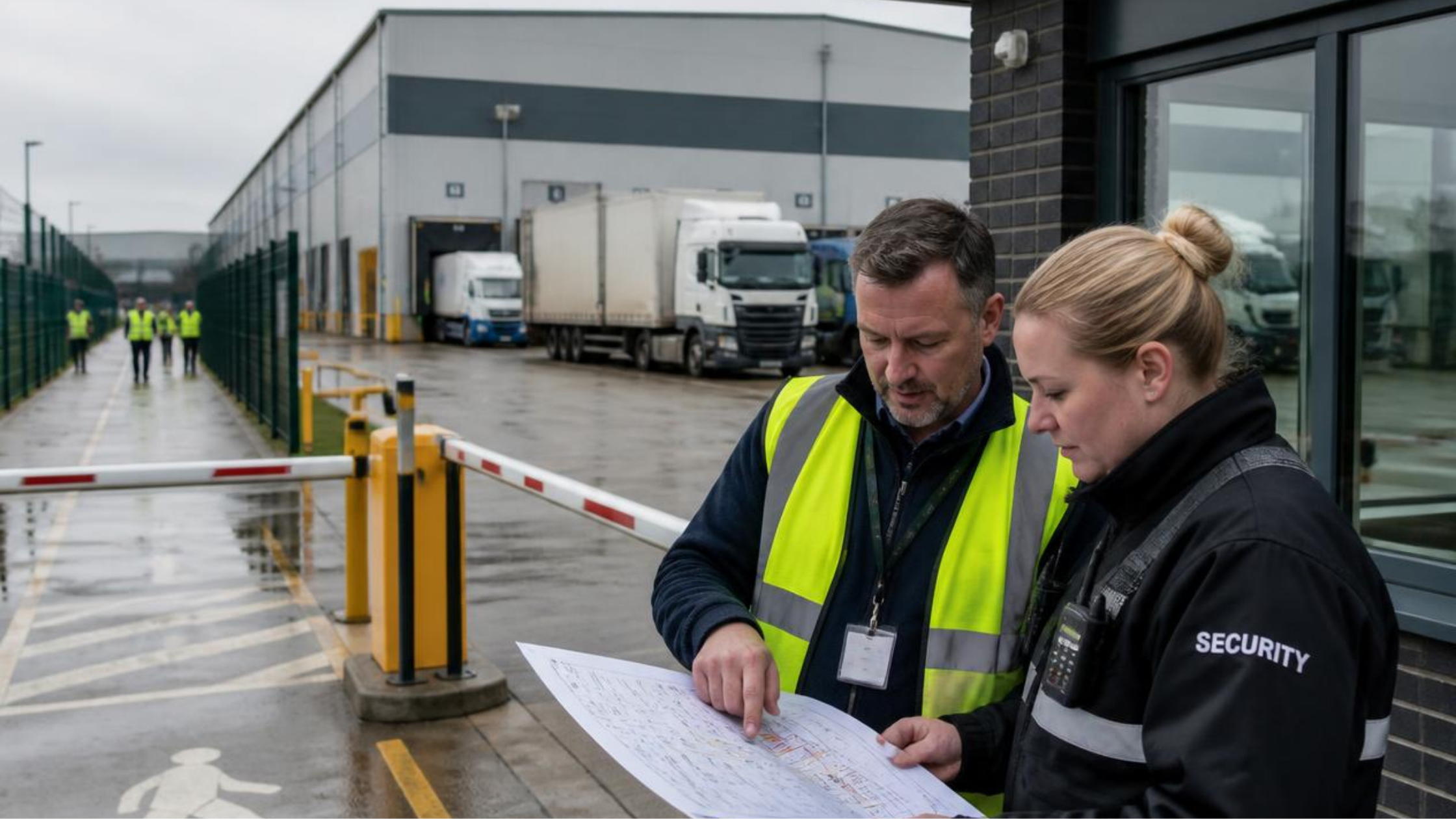
This is one of the areas where warehouse security guards can provide significant operational value.
Depending on the site and agreed procedures, guards can support:
Gatehouse operations
Employee access
Visitor verification
Contractor management
Driver checks
Vehicle movements
Delivery and collection procedures
Key management
Restricted-area access
Incident escalation
Access records
The objective is not simply to have someone standing at an entrance. Effective access control creates a consistent process for understanding who is on the site and whether they should be there. Read more about access control, patrols and the role of security personnel in our guide: How Security Guards Improve Warehouse Safety.
Many logistics operations cannot simply lock their doors at 5pm. Warehouses may operate late shifts, night shifts or continuously to meet delivery schedules and customer expectations.
A distribution centre can still have significant activity at 2am:
HGVs arriving and departing
Employees changing shifts
Goods being loaded
Contractors entering the facility
High-value stock moving through loading areas
At the same time, fewer managers and support personnel may be present. This makes clearly defined warehouse security operations particularly important outside normal business hours. An on-site security officer can provide a consistent security presence, conduct patrols, monitor agreed areas and escalate unusual activity according to site procedures.

Modern warehouse security increasingly relies on technology. CCTV, intrusion detection, access-control systems, monitored alarms and remote surveillance can significantly strengthen logistics facility protection. But detecting an event and dealing with an event are different things. A camera may identify suspicious activity. An alarm may detect an intrusion.An access-control system may record an attempted unauthorised entry.
What happens next?
Depending on the security model, the response could involve:
Detection → Verification → Investigation → Escalation → Resolution → Reporting
This might involve remote monitoring operators, mobile response teams, warehouse management or on-site security personnel.
For higher-risk or continuously operating facilities, combining technology with a trained physical presence can create a stronger layered security model.
Installing cameras does not automatically mean every vulnerable area of a warehouse is effectively monitored. Warehouses change.
Racking moves. Stock profiles change. Loading areas become busier. Temporary structures appear. Vehicles obstruct views. New equipment is installed. These changes can create CCTV blind spots that were not present when the system was originally designed.
That is why CCTV coverage should be reviewed alongside patrol routes, access points and other physical security controls. Warehouse security guards can complement camera coverage by conducting physical patrols through areas that cannot be continuously observed from a control room. The combination creates two different forms of visibility:
Technology provides continuous observation. People provide judgement, investigation and physical response.
The traditional image of a security guard sitting at a gatehouse does not reflect the requirements of many modern logistics facilities. Effective manned guarding shift coordination can involve multiple responsibilities throughout a single shift.
These may include:
Gatehouse duties
Scheduled and random patrols
Access control
Perimeter checks
Loading-bay observations
CCTV support
Contractor verification
Alarm response
Incident reporting
Key control
Shift handovers
Emergency escalation
This makes guard scheduling an important part of the overall security strategy. Deploying the same number of officers throughout every hour of the day may not reflect actual risk. A more effective approach considers when the greatest movement of people, vehicles and goods takes place and aligns security resources accordingly. For example, additional attention may be required around shift changes, high-volume delivery periods or overnight operations.
For warehouse owners and directors, security is ultimately connected to business continuity. Consider a break-in that damages a loading-bay entrance. The immediate problem is unauthorised access.
But if vehicles cannot use that loading bay the following morning, the problem becomes operational.
Likewise, theft of critical equipment could interrupt warehouse processes. Vandalism could close part of a facility. Unauthorised access could create additional health and safety or compliance exposure.
The total impact of an incident can include:
Stock loss
Property damage
Operational downtime
Delayed deliveries
Management time
Investigation costs
Insurance implications
Customer disruption
Reputational damage
This is why effective warehouse and logistics risk management looks beyond individual security measures and considers how different risks could affect the wider operation.
One of the key benefits of warehouse security guards is having trained personnel already at the facility. When suspicious activity or an incident occurs, an officer can assess the situation, follow agreed procedures, secure an area and communicate information to the appropriate people. Depending on their assignment instructions and training, this could include:
Investigating an alarm activation
Checking suspicious activity
Controlling access to an affected area
Contacting management
Supporting evacuation procedures
Liaising with emergency services
Preserving incident information
Completing an incident report
This immediate human capability is difficult to replicate using technology alone.
Not every part of a warehouse presents the same level of exposure at every hour.
This means effective guard scheduling should be based on the site's actual operational patterns.
Security planners should consider:
When are shift changes taking place?
Large numbers of employees entering and leaving simultaneously can create access-control pressure.
When are deliveries at their highest?
Busy loading periods can increase vehicle and visitor movements.
When is management presence lowest?
Overnight and weekend periods may require different escalation procedures.
Where is high-value stock located?
Certain areas may require additional patrol attention or access restrictions.
When is the perimeter most vulnerable?
Lighting, neighbouring activity and seasonal factors can affect exposure.
Good manned guarding shift coordination therefore aligns security resources with risk rather than simply filling a timetable.
For many distribution centres, the answer is not one or the other.
A stronger security model combines complementary controls.
| Security measure | Primary role |
|---|---|
| Warehouse security guards | Visible presence, access control and incident response |
| CCTV | Observation, verification and evidence |
| Intruder alarms | Detection of unauthorised activity |
| Access control | Restricting and recording entry |
| Remote monitoring | Off-site supervision and escalation |
| Mobile response | Physical response without permanent guarding |
| Security procedures | Defining responsibilities and escalation |
Technology can extend the reach of security personnel, while trained personnel can provide judgement and physical response when technology identifies a potential problem.
The appropriate combination depends on the individual facility.
There is no universal answer.
The correct number of warehouse security guards depends on factors including:
Facility size
Site layout
Number of entrances
Perimeter length
Operating hours
Stock value
Vehicle movements
Number of employees and contractors
Patrol requirements
Existing CCTV and alarm coverage
Previous incidents
Emergency response arrangements
This is why adding guards without first understanding the risk can result in unnecessary cost without addressing the site's biggest vulnerabilities.
The starting point should be an assessment.
Circle UK Group's Self-Report Site Risk Assessment Platform provides businesses with a structured way to walk their own sites, examine existing controls and build a clearer picture of their exposure.
Before increasing guarding hours or changing security providers, ask:
Review gates, entrances, loading bays, emergency exits, yards and perimeter boundaries.
Consider nights, weekends, shift changes and high-volume delivery periods.
Think beyond stock value. Machinery, vehicles, IT infrastructure and specialist equipment can be essential to maintaining operations.
Consider how identities, permissions and movements are verified.
There should be a clear answer about who verifies the event, who responds and who is informed.
Review posts, patrol routes, schedules and responsibilities against operational activity.
A security solution designed several years ago may no longer reflect how the warehouse operates today.
Effective warehouse security operations should be proportionate to the risk and integrated with the way the facility actually operates.
A practical security strategy should answer seven questions:
Security guarding then becomes one part of a wider risk-control system rather than an isolated service.
For a more comprehensive approach covering physical security, health and safety, compliance, governance and environmental management, explore the Circle UK Group Self-Report Site Risk Assessment Platform.
Have Question? We are here to help
Warehouse security guards help protect people, stock, buildings and operations by controlling access, conducting patrols, monitoring suspicious activity and responding to incidents. Their responsibilities may also include gatehouse operations, contractor verification, CCTV support, key control and security reporting.
On-site security personnel provide a physical security presence and an immediate response capability. They can investigate suspicious activity, control access and respond according to established site procedures when alarms or incidents occur.
Not every warehouse requires 24/7 guarding. Requirements depend on operating hours, location, stock value, site layout, access arrangements, previous incidents and existing security technology. A security risk assessment should determine the appropriate level of coverage.
CCTV provides valuable observation, verification and evidence, but it cannot physically investigate an incident. Many warehouses therefore combine CCTV with alarms, access control, remote monitoring, mobile response and security personnel.
The appropriate number depends on facility size, access points, operating hours, patrol requirements, risk level and the duties assigned to each officer. A site-specific assessment should be completed before determining staffing levels.
Manned guarding shift coordination is the process of organising officers, security posts, patrols, breaks, responsibilities and handovers across different shifts to maintain appropriate security coverage.
Guard scheduling should reflect periods of higher operational risk, including shift changes, delivery peaks, nights, weekends and periods when management presence is reduced. Scheduling guards according to risk can be more effective than maintaining identical deployment levels throughout the day.
There is no single best solution for every distribution centre. Effective distribution site security usually combines appropriate physical security, access control, CCTV, alarms, monitoring, security personnel and documented response procedures based on the facility's risk profile.
Demand for warehouse security guards is being driven by more than concern about theft.
Modern warehouses are complex operational environments. People, vehicles and goods are constantly moving. Facilities may operate around the clock, while a relatively small security incident can quickly create significant operational disruption.
For warehouse owners and directors, the priority should therefore be to understand the exposure first.
At Circle UK Group, our approach begins by identifying the risks across the site and understanding how existing security controls support the wider operation.
The objective is not simply to put more guards on site.
It is to establish the right combination of people, technology and procedures to protect the operation.
Walk your site, review your existing controls and identify areas that may need further attention with our Self-Report Site Risk Assessment Platform.
Or speak to Circle UK Group about reviewing your warehouse and distribution site security.
UK warehouses face mounting pressure from theft, unauthorised access, and supply chain disruption. Yet the most effective solution remains...
Why Vacant Properties Are at High Risk Vacant and unoccupied properties are among the most vulnerable assets in the UK. Whether a building is empty...
In today’s fast-paced construction industry, protecting your site is essential. Construction sites remain common targets for theft, vandalism, and...