Warehouse Security Guards: How a Risk Assessment Builds Better Protection
Warehouse security guards are most effective when their duties are based on how a site actually operates, not on a generic post schedule. Warehouses...
8 min read
Circle Editor
:
Updated on September 18, 2026
Fire safety assessments can become outdated while a distribution hub remains busy, productive and apparently well controlled. An extension opens, racking moves, stock volumes rise, battery-charging areas expand or a new shift begins. Each decision may look operational in isolation, but together they can change fire hazards, escape conditions and the effectiveness of existing precautions.
For owners and operations directors, the central compliance question is not whether an assessment exists. It is whether the assessment accurately reflects the site as it operates today. A suitable approach connects fire safety to expansion planning, operational change and day-to-day industrial safety management.
Quick answer: What leads UK distribution hubs to overlook formal fire safety assessments?
Assessments are commonly overlooked when expansion and operational changes are managed primarily around capacity, cost and deadlines. Fire safety review sits outside the change-control process, so several small changes can accumulate before anyone tests their combined effect on hazards, evacuation, detection, suppression or emergency response. The practical solution is to make fire risk review a mandatory gate before a material change is approved, commissioned or brought into use.

Distribution hubs rarely stand still. They adapt to customer demand, seasonal peaks, automation, new contracts and changes in the way goods move through the building. That pace creates several predictable reasons why a formal review may be delayed.
An expansion may be led by property, engineering, procurement or operations. The project team naturally focuses on floor space, equipment, labour, cost and go-live dates. If fire safety is not included in the project brief, key questions may only be raised after the new layout is already operating.
One additional charging point, a temporary storage lane or a revised picking route may appear minor. Repeated changes can, however, alter travel distances, narrow escape routes, obscure signs, increase combustible loading or place new hazards beyond the intended coverage of existing systems.
Owners, employers, occupiers, managing agents, facilities teams and third-party logistics providers may each control part of the premises or operation. Where responsibilities are not documented and co-ordinated, every party may assume that somebody else has reviewed the fire implications.
An alarm, sprinkler system or smoke-control arrangement is important, but its presence does not prove that the overall risk remains acceptable. The system may have been designed for a different layout, commodity, ceiling clearance, occupancy or operating pattern. Maintenance records alone do not answer whether the control remains appropriate for the current risk.
A diary date can support good governance, but it should not delay action after a significant change, control failure, fire or near miss. A fire risk assessment is a living decision document, not an annual administrative exercise.
Fire safety law is devolved across the UK. In England and Wales, the Regulatory Reform (Fire Safety) Order 2005 places duties on the responsible person. Scotland and Northern Ireland operate under different legislation and terminology, so organisations with sites in several nations should verify the requirements that apply to each location.
For premises within the responsible-person framework, the duty includes carrying out and regularly reviewing a fire risk assessment, recording it, implementing appropriate fire precautions, planning for emergencies and providing information and training. The assessment must consider the people who may be affected as well as the physical hazards.
The GOV.UK fire risk assessment guidance describes five core steps: identify hazards, identify people at risk, evaluate and reduce risk, record findings and prepare plans, then review and update the assessment. The Home Office also provides detailed guidance for factories and warehouses.
Compliance is therefore not achieved by holding a generic document. The assessment should be suitable for the building, activities, stock, people, systems and management arrangements at the specific site. Its significant findings must lead to proportionate action, with controls maintained and responsibilities understood.
There is no single review interval that makes every site compliant. Reviews should be regular and should also take place when there is reason to believe the assessment is no longer valid or when a significant change affects fire risk or precautions. The change should ideally be assessed before it is introduced.
| Review trigger | What may have changed | Immediate management question |
|---|---|---|
| Extension or alteration | Mezzanines, partitions, loading bays, doors, stairs, offices, plant rooms or compartment lines | Do escape, detection, suppression and fire-resisting construction still perform as intended? |
| Racking or stock change | Racking height, aisle width, storage density, packaging, commodity type, returns or waste | Has the fire load or the way a fire could develop and spread changed? |
| New process or equipment | Automation, conveyors, machinery, hot work, charging areas, electrical demand or hazardous substances | What new ignition sources or failure modes have been introduced? |
| People or shift change | More employees, agency labour, contractors, visitors, lone workers, night shifts or people needing assistance | Can everyone receive a warning, understand the plan and reach safety at every operating time? |
| Control impairment or incident | Alarm, sprinkler, smoke-control or fire-door failure; a fire, near miss or recurring unwanted alarm | Are temporary precautions adequate, and what does the event reveal about the assessment? |
| Change of control | New tenant, landlord, managing agent, contractor, 3PL partner or maintenance provider | Are duties, information-sharing and emergency arrangements still clearly allocated? |
A credible fire risk assessment follows the movement of people, goods and vehicles through the actual operation. It should test normal activity, busy periods, nights, weekends, maintenance, shutdowns and foreseeable abnormal conditions.
The assessment should identify what is stored, how it is packaged, where it is located and how quantities vary. Changes in plastics, aerosols, flammable materials, batteries, packaging or waste can affect ignition, fire growth and firefighting. Racking configuration, clearances and segregation should reflect the assumptions behind the site's fire strategy and protection systems.
Escape should be tested against the current layout, occupancy and working practices. Consider travel distances, route width, final exits, door operation, emergency lighting, signs and assembly arrangements. Pay particular attention to temporary stock, parked equipment, security controls and work at height or on mezzanines. Arrangements should cover visitors, contractors, agency workers and anyone who may require assistance.
Check whether detection reaches all relevant areas and whether warning devices can be perceived in noisy operations, isolated rooms, yards and welfare spaces. Where sprinklers or other suppression systems are present, confirm that changes in storage, obstructions, water supplies and maintenance have not undermined the design assumptions. Interfaces between alarms, doors, conveyors, lifts, smoke control and monitoring should be understood and tested.
Electrical equipment, charging, heating, maintenance, hot work, vehicle operations and contractor activity all require effective controls. The assessment should address isolation, inspection, permits, supervision, housekeeping and the safe management of defects. Temporary work should receive the same scrutiny as permanent installations.
Fire doors, hydrants, access roads, gates, key information and isolation points must remain available as the site changes. Plans should identify who raises the alarm, calls the fire and rescue service, manages evacuation, supports people who need assistance and communicates relevant hazards to responders. Arrangements must work on every shift, not only when senior managers are present.
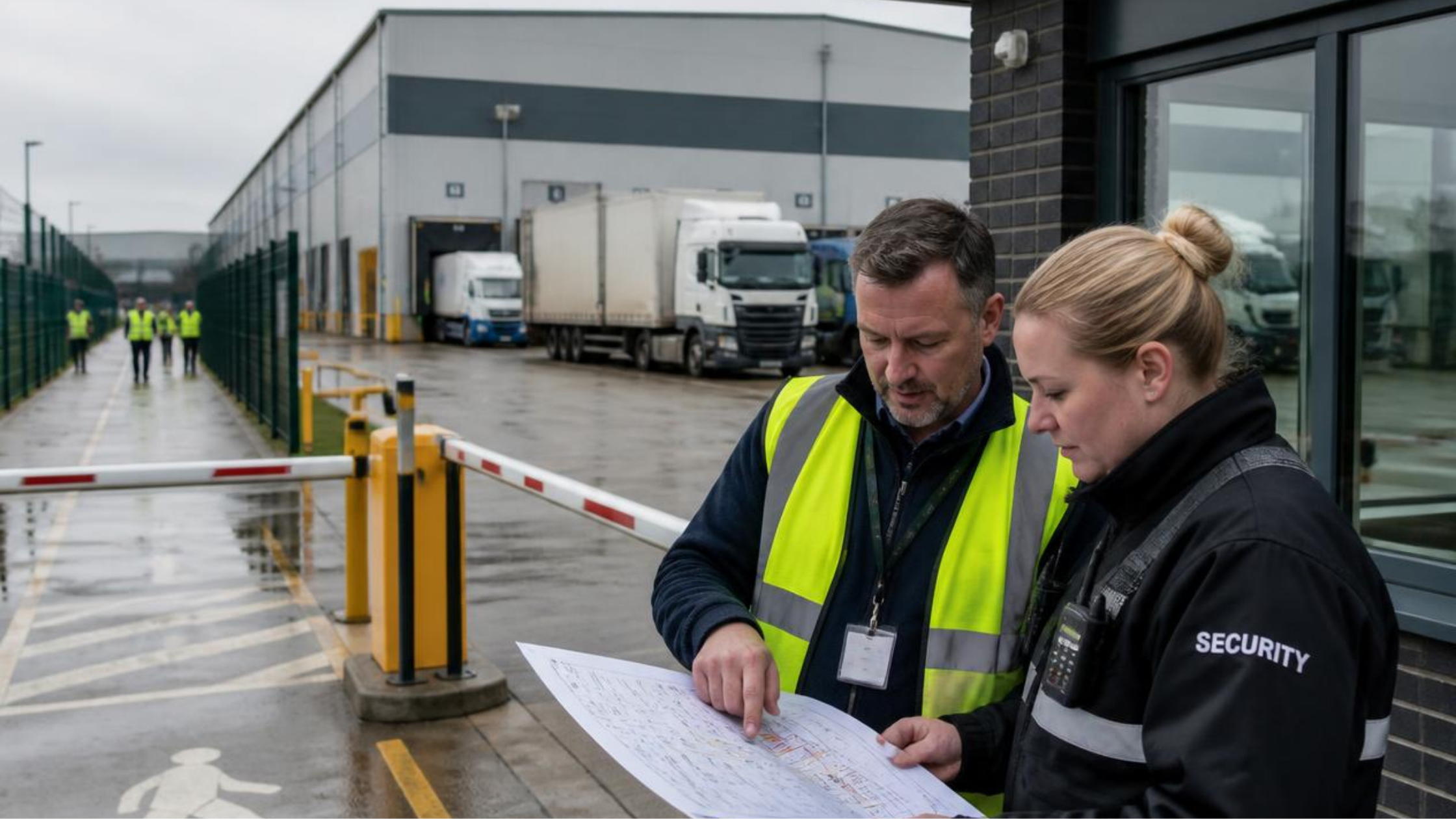
Fire precautions interact with security, workplace transport and business-continuity controls. A locked gate may improve security but delay evacuation or emergency access. A safer pedestrian route may also change how people reach final exits. Circle UK Group's guide to a warehouse security risk assessment explains why controls should be tested against real routes, shifts and operating conditions rather than considered in isolation.
Every project brief should include a simple screening question: could this change affect fire hazards, people at risk, escape, compartmentation, detection, suppression, firefighting or emergency management? A positive or uncertain answer should trigger competent review before approval.
Use updated drawings, equipment specifications, storage profiles, occupancy assumptions and operating scenarios. Include temporary construction phases and the transition to the new operation. Controls required for safe commissioning should be identified before the go-live date.
The responsible person retains accountability even when a specialist completes or reviews the assessment. Competent advice is particularly important where the site is large or complex, where significant alterations are planned, where fire-engineered systems are involved or where internal teams do not have sufficient knowledge and experience.
Separate actions that must be complete before occupation or operation from longer-term improvements. Life-safety-critical measures, safe escape, effective warning and agreed temporary arrangements should not be left as open actions without clear authority, controls and timescales.
Drawings and certificates are valuable, but the changed area should also be walked and tested. Confirm that doors close, routes remain clear, signs are visible, alarms are audible, interfaces operate, emergency access is maintained and relevant records have been handed over.
Update emergency plans, induction, local instructions and role-specific training. Include agency workers, contractors and people working during quieter periods. A drill or scenario exercise can reveal issues that drawings and desktop reviews miss.
Track overdue actions, impaired systems, blocked exits, fire-door defects, unwanted alarms, housekeeping issues, training completion and drill findings. Management review should consider trends and repeated weaknesses, not only whether an inspection was completed.
Records should create a clear line from identified risk to completed action. Depending on the premises and applicable law, the evidence may include:
For a wider view of operational exposure, Circle UK Group's self-report risk assessment platform can help teams structure site observations across safety, security, compliance and governance. It supports risk identification and prioritisation but does not replace a statutory or specialist fire risk assessment where one is required.
Have Question? We are here to help
Review it regularly and whenever there is reason to believe it is no longer valid or a significant change affects the premises, activities, people or fire precautions. A fixed annual date may support governance, but it should never delay a review triggered by expansion, changed storage, new equipment, an incident or a control failure.
An expansion or material alteration should trigger review before the changed area is brought into use. The review should consider new hazards, escape, compartmentation, detection, suppression, emergency access, occupancy and the interaction between the new area and the existing building.
In England and Wales, the responsible person may be the employer, owner, occupier or another person with control of the premises. More than one responsible person can exist, and they must co-operate and co-ordinate. Scotland and Northern Ireland use different legislative frameworks, so site-specific legal responsibilities should be confirmed.
A single corporate framework can improve consistency, but each assessment must reflect the hazards, people, layout, systems and management arrangements at the individual premises. A generic assessment that does not address site-specific conditions is unlikely to provide an adequate basis for control.
Typical triggers include alterations, new racking, changed stock or packaging, increased storage, new machinery, charging areas, changed shifts or occupancy, new contractors, impaired systems, a fire, a near miss or evidence that existing precautions are no longer effective.
No. Testing and maintenance help demonstrate that individual systems are available, but the assessment must also determine whether those systems remain suitable for the current hazards, storage arrangement, building layout, occupancy and emergency plan.
Useful evidence includes the assessment and reviews, significant findings, action plans, site information, maintenance and test records, training and drills, impairment arrangements, incident investigations, dutyholder co-ordination and proof that completed improvements were verified.
Competent support should be considered whenever internal teams lack the knowledge or time to complete a suitable assessment. It is especially important for large or complex premises, significant alterations, unusual storage, engineered fire systems or situations where the adequacy of existing controls is uncertain.
Distribution hubs change because the business needs them to change. Compliance depends on making fire safety part of that process rather than reviewing it after the operational decision has been implemented.
The most reliable approach is straightforward: identify fire-safety implications early, obtain competent input where needed, complete critical controls before go-live, brief the people affected and retain evidence that the arrangements work. That keeps fire safety assessments relevant to the real site and supports safer, more resilient operations.
Circle UK Group helps organisations identify, assess, mitigate and monitor operational risk across complex working environments.
Warehouse security guards are most effective when their duties are based on how a site actually operates, not on a generic post schedule. Warehouses...
UK warehouses face mounting pressure from theft, unauthorised access, and supply chain disruption. Yet the most effective solution remains...
Understanding Fire Safety in the Workplace Fire safety is a legal, operational, and moral obligation for every organisation in the UK. It ensures...