---
title: "YouTube Auditors UK: How Security Teams Should Respond Professionally"
description: Learn how UK security professionals should handle YouTube auditors and public filming legally, safely, and professionally while protecting site security and reputation.
image: https://circleukgroup.co.uk/hubfs/Screenshot%202026-04-28%20at%2013.44.00.png
---
[Skip to the main content.](https://circleukgroup.co.uk/safe-circle/youtube-auditors-uk-security-response-guide#main-content)
**CIRCLE UK GROUP** | SECURITY, SAFETY AND COMPLIANCE IN ONE SOLUTION
[Download Circle Overwatch](https://circleukgroup.co.uk/circle-overwatch) | 24/7 Helpline: **[020 3988 2444](tel:02039882444)**
[](https://circleukgroup.co.uk)
[](https://circleukgroup.co.uk)
- [Industries We Protect](https://circleukgroup.co.uk/protecting-businesses-across-sectors)
- [Integrated Solutions](https://circleukgroup.co.uk/complete-security-solutions)
- [Meet The Team](https://circleukgroup.co.uk/meet-the-team)
- [Insights](https://circleukgroup.co.uk/safe-circle)
- [Case Studies](https://circleukgroup.co.uk/case-studies)
- [News](https://circleukgroup.co.uk/safe-circle)
- [Training & Courses](https://circleukgroup.co.uk/circle-academy)
[Contact Us 24/7](https://circleukgroup.co.uk/contact)
Toggle Menu
Toggle Menu
[Contact Us 24/7](https://circleukgroup.co.uk/contact)
- [Industries We Protect](https://circleukgroup.co.uk/protecting-businesses-across-sectors)
- [Integrated Solutions](https://circleukgroup.co.uk/complete-security-solutions)
- [Meet The Team](https://circleukgroup.co.uk/meet-the-team)
- [Insights](https://circleukgroup.co.uk/safe-circle)
- [Case Studies](https://circleukgroup.co.uk/case-studies)
- [News](https://circleukgroup.co.uk/safe-circle)
- [Training & Courses](https://circleukgroup.co.uk/circle-academy)
- [Request Risk Assessment](https://circleukgroup.co.uk/en/identify-risks-tailored-mitigation-plans-circle-uk-group)
- [Security Services](https://circleukgroup.co.uk/security-services-uk)
- [Circle Alarm System](https://circleukgroup.co.uk/circle-alarm-systems)
- [Compliance & Training](https://circleukgroup.co.uk/circle-academy)
- [Stay informed - Sign Up](https://circleukgroup.co.uk/newsletter)
- [Download the Overwatch app](https://circleukgroup.co.uk/circle-overwatch)
[Facebook](https://www.facebook.com/circleukgroup) [Linkedin](https://www.linkedin.com/company/circleukgroup/) [YouTube](https://www.youtube.com/channel/UC8ckYEBLGRFEXxCfSvfOimA)
4 min read
# Professionalism Under the Lens: Managing YouTube Auditors and Public Filming
[ Benita Hajdas](https://circleukgroup.co.uk/safe-circle/author/benita-hajdas) : Updated on May 28, 2026
[Security](https://circleukgroup.co.uk/safe-circle/tag/security) [News](https://circleukgroup.co.uk/safe-circle/tag/news)
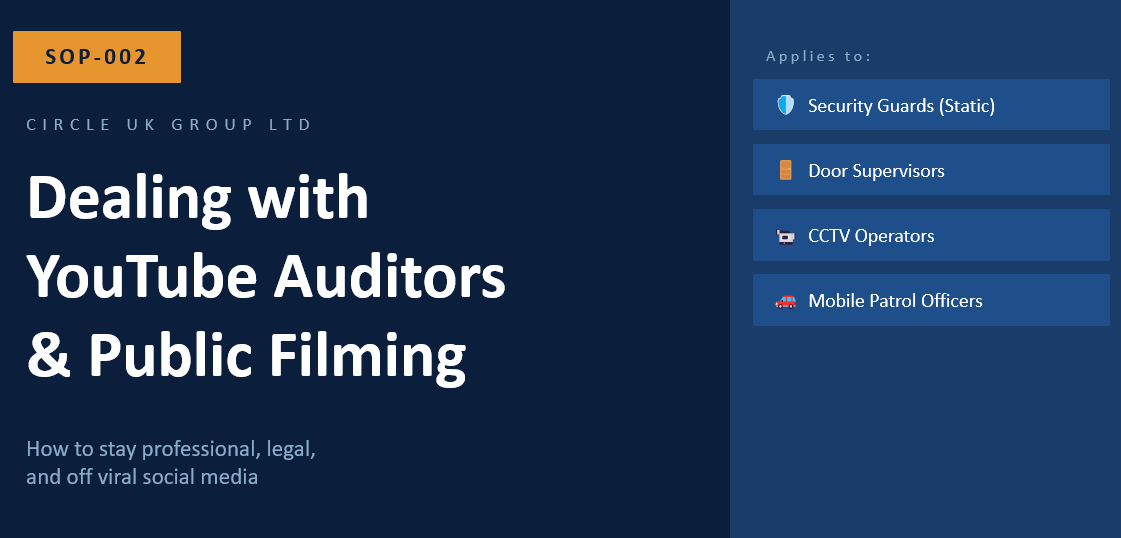
YouTube Auditors UK: How Security Teams Should Respond Professionally
8:07
## **How Should Security Handle YouTube Auditors in the UK?**
Across the UK, security personnel are increasingly encountering individuals known as “YouTube auditors.” These interactions are no longer rare and can quickly escalate if not handled correctly.
For businesses and security teams, the challenge is not just managing the situation in the moment. It is about maintaining professionalism, protecting site integrity, and avoiding unnecessary risk exposure.
Understanding how to respond confidently and legally is now a critical part of modern security operations.
## **What Are YouTube Auditors and Why Do They Film?**
YouTube auditors are independent content creators who film security responses in public or semi-public environments. They are not inspectors, regulators, or journalists, and they hold no legal authority over a site or its staff.
Their objective is often simple. They aim to provoke a reaction that can be edited into engaging or controversial online content. Poor handling by security staff, such as confrontation or incorrect use of legal language, often becomes the highlight of these videos.
A calm and controlled response removes the value from the interaction and protects both the individual and the organisation.
## **The Wider Risk: Why This Matters for Businesses**
While these encounters may appear harmless, there is a broader risk that businesses cannot ignore.
Footage shared online can expose sensitive details such as [CCTV coverage](https://circleukgroup.co.uk/safe-circle/cctv-installation-uk-remote-monitoring-security), access points, patrol routines, and vulnerabilities. According to guidance from the [National Protective Security Authority](https://www.npsa.gov.uk/), this type of publicly available information can be exploited by individuals with malicious intent.
For organisations operating in construction, infrastructure, retail, and other public-facing sectors, this creates a real security concern that goes beyond the initial interaction.
## **Training Video: Handling YouTube Auditors**
To support security teams in real-world situations, we have included a practical training video that demonstrates how to manage interactions with YouTube auditors professionally and in line with UK law.
The video covers key scenarios, including public filming, private property engagement, and how to apply a calm, structured response under pressure.
This resource is designed to reinforce best practice and help officers respond with confidence, consistency, and control.
### Watch now to see how professional security teams handle these situations correctly.
### Get free access to the training below 👇
*This article is for information purposes only and does not constitute legal advice.*
## **Legal Boundaries: What Auditors Can and Cannot Do**
A clear understanding of UK law is essential for a confident and professional response.
Individuals are generally permitted to film from public land, including pavements and roads, even if your site or staff are visible. They may also use zoom lenses or drones, provided they comply with aviation regulations.
However, their rights are not unlimited. They cannot enter private property without permission, obstruct operations, or behave in a way that causes harassment, alarm, or distress under the Public Order Act 1986.
For security teams, the key is understanding where public rights end and private property rights begin.
## **The Importance of a Calm, Structured Response**
In these situations, professionalism is not just good practice. It is your strongest control measure.
A structured approach helps reduce escalation, protects your organisation’s reputation, and ensures compliance with legal and operational standards. The focus should always be on observation, assessment, and controlled engagement rather than confrontation.
[](https://cta-redirect.hubspot.com/cta/redirect/20415666/d8c9399d-5422-471f-930a-feb4e69176f0)
## **A Practical Approach to Managing Public Filming Incidents**
When an individual is filming near your site, the first step is to assess the situation rather than react immediately. Taking a moment to observe behaviour, location, and intent allows for a more informed response.
If the individual remains on public land, there is often no requirement to engage. Monitoring from a distance and notifying a supervisor or control room is usually the most appropriate action.
If the individual enters private property, a calm and professional approach is required. Clearly identifying the boundary and politely asking them to return to public space is sufficient. There is no need for extended discussion or confrontation.
Maintaining distance, avoiding physical interaction, and limiting communication to clear, simple statements helps prevent escalation and removes the incentive for further engagement.
## **Communication: Why Less Is More**
In these encounters, over-communication can create risk.
Providing too much information, engaging in debate, or attempting to challenge the individual’s actions can escalate the situation and create content that may be shared online.
A short, clear statement delivered calmly is far more effective. Once communicated, disengaging and continuing to monitor the situation is the safest approach.
## **Post-Incident Reporting and Accountability**
Every interaction of this nature should be documented.
Accurate reporting ensures there is a clear record of what occurred, supports operational review, and provides evidence if further action is required.
Details such as timings, behaviour, location, and exact wording of any interaction are critical. Where there are concerns around hostile reconnaissance, incidents should be escalated appropriately in line with company procedures and reported via non-emergency police channels if necessary.
Consistent reporting strengthens organisational awareness and improves future response.
## **Why This Matters for Modern Security Operations**
Encounters with YouTube auditors highlight a wider shift in the security landscape.
Security is no longer just about physical presence. It is about behaviour, communication, and the ability to manage situations professionally under scrutiny.
Every interaction has the potential to be recorded, shared, and analysed. This makes consistency, training, and awareness essential for all security personnel.
## **How Circle UK Group Supports Businesses and Security Teams**
At Circle UK Group, we recognise that situations like these require more than just basic security presence. They require clarity, training, and a structured approach to risk management.
We support organisations by helping them strengthen procedures, improve staff awareness, and ensure that teams are equipped to respond confidently in real-world scenarios.
This includes reviewing site-specific risks, refining incident response processes, and providing practical training through Circle Academy to build confidence and consistency across teams.
[](https://cta-redirect.hubspot.com/cta/redirect/20415666/68d5d6d5-071f-454b-9d6b-3de44a06cd28)
The focus is always on supporting businesses in maintaining professionalism, reducing risk exposure, and protecting both people and reputation in an evolving security environment.
## Managing YouTube auditors is not about confrontation. It is about control.
A calm, informed, and consistent approach protects your organisation, your team, and your reputation. It also ensures that security remains focused on its primary objective, which is safeguarding people and assets.
As public filming becomes more common, the organisations that succeed will be those that respond with professionalism, not reaction.
[](https://cta-redirect.hubspot.com/cta/redirect/20415666/6bbeff20-e67d-44e5-9542-e202f3fdc66d)
## Frequently Asked Questions
Have Question? We are here to help
###### Can someone film my workplace in the UK?
Yes, if they are on public land, they are generally allowed to film.
###### Can a security guard ask someone to stop filming?
Only if they are on private property or breaking the law.
###### Can security guards touch or block cameras?
No, this can escalate the situation and may be unlawful.
###### Are YouTube auditors legal in the UK?
Yes, as long as they follow the law like any other member of the public.
---
- [Tweet](https://twitter.com/share)
### Explore More
[](https://cta-redirect.hubspot.com/cta/redirect/20415666/00ca0807-6575-4d48-91db-0b8eda3bb99f)
---
### Stay Ahead of Security, Compliance & Risk
Join over **5,000 professionals** receiving practical insights, industry updates and expert guidance on security, compliance, health & safety and business continuity.
### Posts by Tag
- [Security (54)](https://circleukgroup.co.uk/safe-circle/tag/security)
- [News (31)](https://circleukgroup.co.uk/safe-circle/tag/news)
- [Risk Management (21)](https://circleukgroup.co.uk/safe-circle/tag/risk-management)
- [Health & Safety (14)](https://circleukgroup.co.uk/safe-circle/tag/health-safety)
- [Risk Assessment (14)](https://circleukgroup.co.uk/safe-circle/tag/risk-assessment)
- [Workplace Compliance (12)](https://circleukgroup.co.uk/safe-circle/tag/workplace-compliance)
- [Circle Academy (11)](https://circleukgroup.co.uk/safe-circle/tag/circle-academy)
- [HR Compliance (10)](https://circleukgroup.co.uk/safe-circle/tag/hr-compliance)
- [Warehouse Security (7)](https://circleukgroup.co.uk/safe-circle/tag/warehouse-security)
- [Security in Construction (6)](https://circleukgroup.co.uk/safe-circle/tag/security-in-construction)
- [CCTV (5)](https://circleukgroup.co.uk/safe-circle/tag/cctv)
- [Circle Alarms (5)](https://circleukgroup.co.uk/safe-circle/tag/circle-alarms)
- [Waking Watch Service (4)](https://circleukgroup.co.uk/safe-circle/tag/waking-watch-service)
- [Manned Guarding (3)](https://circleukgroup.co.uk/safe-circle/tag/manned-guarding)
- [Circle Overwatch (2)](https://circleukgroup.co.uk/safe-circle/tag/circle-overwatch)
- [Fire Safety (2)](https://circleukgroup.co.uk/safe-circle/tag/fire-safety)
- [Demolition Site Security (1)](https://circleukgroup.co.uk/safe-circle/tag/demolition-site-security)
- [Facility Management (1)](https://circleukgroup.co.uk/safe-circle/tag/facility-management)
See All
[](https://circleukgroup.co.uk/safe-circle/proactive-risk-focused-security)
1 min read
#### [Proactive & Risk-Focused Security: Shifting from Reactive to Strategic Protection](https://circleukgroup.co.uk/safe-circle/proactive-risk-focused-security)
[ Circle Editor](https://circleukgroup.co.uk/safe-circle/author/circle-editor) : Feb 20, 2026, 2:18:04 PM
Strengthening Protection Through Strategy A Blended, Data-Driven Approach to Protecting What Matters Physical security remains a fundamental...
[Security](https://circleukgroup.co.uk/safe-circle/tag/security) [News](https://circleukgroup.co.uk/safe-circle/tag/news)
[Read More](https://circleukgroup.co.uk/safe-circle/proactive-risk-focused-security)
[](https://circleukgroup.co.uk/safe-circle/vacant-property-security-in-the-uk-how-to-protect-empty-buildings-from-theft-vandalism-squatting)
1 min read
#### [Vacant Property Security: Protecting Empty Buildings](https://circleukgroup.co.uk/safe-circle/vacant-property-security-in-the-uk-how-to-protect-empty-buildings-from-theft-vandalism-squatting)
[ Circle Editor](https://circleukgroup.co.uk/safe-circle/author/circle-editor) : Dec 22, 2025, 10:26:56 AM
Why Vacant Properties Are at High Risk Vacant and unoccupied properties are among the most vulnerable assets in the UK. Whether a building is empty...
[Security](https://circleukgroup.co.uk/safe-circle/tag/security) [CCTV](https://circleukgroup.co.uk/safe-circle/tag/cctv) [Circle Alarms](https://circleukgroup.co.uk/safe-circle/tag/circle-alarms)
[Read More](https://circleukgroup.co.uk/safe-circle/vacant-property-security-in-the-uk-how-to-protect-empty-buildings-from-theft-vandalism-squatting)
[](https://circleukgroup.co.uk/safe-circle/search-procedures-and-legal-powers-for-security-officers)
1 min read
#### [Search Procedures and Legal Powers for Security Officers](https://circleukgroup.co.uk/safe-circle/search-procedures-and-legal-powers-for-security-officers)
[ Circle Editor](https://circleukgroup.co.uk/safe-circle/author/circle-editor) : Feb 20, 2026, 9:32:52 AM
Safe, Consensual and Ethical Searching in Line with UK Law Security officers play a critical role in protecting people, property and reputation....
[Security](https://circleukgroup.co.uk/safe-circle/tag/security) [News](https://circleukgroup.co.uk/safe-circle/tag/news)
[Read More](https://circleukgroup.co.uk/safe-circle/search-procedures-and-legal-powers-for-security-officers)
CIRCLE UK GROUP
CIRCLE UK GROUP
**One Partner. Total Risk Control.**
Helping organisations reduce operational risk through integrated security, health & safety, compliance, training and technology solutions.
SOLUTIONS
SOLUTIONS
- [Security & Risk Management](https://circleukgroup.co.uk/security-services-uk)
- [Circle Academy](https://circleukgroup.co.uk/circle-academy)
- [Circle Alarm Systems](https://circleukgroup.co.uk/circle-alarm-systems)
- [Circle Overwatch](https://circleukgroup.co.uk/circle-overwatch)
- [Circle Risk Solutions NL](https://circlerisksolutions.nl/nl)
- [Franchise opportunities](https://circleukgroup.co.uk/become-a-franchise-partner-risk-management-and-security-services-circle-uk)
RESOURCES
RESOURCES
- [Free Risk Self-Assessment](https://circleukgroup.co.uk/assessment)
- [Safe Circle](https://circleukgroup.co.uk/newsletter)
- [Case Studies](https://circleukgroup.co.uk/case-studies)
- [Insights](https://circleukgroup.co.uk/safe-circle)
- [Careers](https://circleukgroup.co.uk/join-us/)
- [Join our Supply Chain](https://circleukgroup.co.uk/join-our-supply-chain/)
COMPANY
COMPANY
- [Meet the Team](https://circleukgroup.co.uk/meet-the-team)
- [Accreditations & Certifications](https://circleukgroup.co.uk/accreditations-compliance-standards-trusted-partner-circle-uk-group)
- [Policies & Governance](https://circleukgroup.co.uk/en/policy-information)
- [Contact Us](https://circleukgroup.co.uk/contact)
CONTACT
CONTACT
Office: [020 3988 2444](tel:+442039882444)
24/7 Control Centre: [020 3239 9991](tel:+442032399991)
##### Head Office
Theobalds Enterprise Centre, Platinum Way, Cheshunt, Waltham Cross EN8 8YD
[](https://circleukgroup.co.uk/old)
- [Privacy Policy](https://circleukgroup.co.uk/en/policy-information)
- [Terms of Service](https://circleukgroup.co.uk/en/cukg-general-terms-and-conditions)
© 2026 Circle UK Group. All rights reserved. Company registered in England and Wales.
[Facebook](https://www.facebook.com/circleukgroup)[X](https://x.com/CircleUKGroup)[Instagram](https://www.instagram.com/circleukgroup/)[Linkedin](https://uk.linkedin.com/company/circleukgroup)[YouTube](https://www.youtube.com/channel/UC8ckYEBLGRFEXxCfSvfOimA)
Return to top
```json
{
"@context" : "https://schema.org",
"@type" : "BlogPosting",
"author" : {
"@type" : "Person",
"name" : "Benita Hajdas",
"url" : "https://circleukgroup.co.uk/safe-circle/author/benita-hajdas"
},
"dateModified" : "2026-05-28T16:23:06.738Z",
"datePublished" : "2026-04-28T13:08:46.000Z",
"headline" : "YouTube Auditors UK: How Security Teams Should Respond Professionally",
"image" : [ "https://circleukgroup.co.uk/hubfs/Screenshot%202026-04-28%20at%2013.44.00.png" ],
"mainEntityOfPage" : {
"@id" : "https://circleukgroup.co.uk/safe-circle/youtube-auditors-uk-security-response-guide",
"@type" : "WebPage"
},
"publisher" : {
"@type" : "Organization",
"logo" : {
"@type" : "ImageObject",
"url" : "https://circleukgroup.co.uk/hubfs/New%20Logo%20CUKG/CUKG_Logo_color-2-1.png"
},
"name" : "Circle UK Group Ltd"
}
}
```
```json
{
"@context" : "https://schema.org",
"@type" : "VideoObject",
"caption" : {
"@type" : "MediaObject",
"contentUrl" : "https://circleukgroup.co.uk/media-transcripts/211853983647/en.vtt",
"inLanguage" : "en",
"name" : "en Captions"
},
"contentUrl" : "https://20415666.fs1.hubspotusercontent-na1.net/hubfs/20415666/video_assets/211853983647/inherited/web_optimized.mp4",
"dateModified" : "2026-05-28T16:20:38.028Z",
"description" : "Learn how UK security professionals should handle YouTube auditors and public filming legally, safely, and professionally while protecting site security and reputation.",
"duration" : "PT6M14.491S",
"height" : 720,
"name" : "Are YouTube auditors legal in the UK?",
"thumbnailUrl" : "https://20415666.fs1.hubspotusercontent-na1.net/hubfs/20415666/are-youtube-auditors-legal-in-the-uk.mp4/medium.jpg",
"uploadDate" : "2026-04-28T12:47:02.252Z",
"width" : 1280
}
```